
Act Naturally
Hyperindividualism, Charlie Kirk and Modern “Politics”
By Alice Springs
…They’re gonna put me in the movies
They’re gonna make a big star out of me
They’re makin’ a film about a man that’s sad and lonely
And all I got to do is act naturally…1
Unfortunately, your annoying friend who loves to say that we are all living in a simulation is getting harder and harder to refute by pointing to the real world.
Yesterday, Charlie Kirk, who was in the middle of one of his circlejerk debate me! rallies designed to sell pseudointellectual bourgeois hatespeech and overly large MAGA hats to impressionable young mormons, got his shit absolutely blipped by a terminally online and alienated young shooter. Everyone rushed to social media to give their takes. Trump shed a tear. Charlie Kirk died in a hospital in Utah.
The symbolism of it all is too much. Way too much. And that’s probably why everyone was bursting to give their version of What Really Happened – what the media isn’t telling you.
It was all a set-up.
The CIA is at it again!
It was a sacrificial psyop by intelligence mastermind Donald Trump.
The woke liberals are out to take my guns and shoot my thick-skulled pseuds!
What really happened, as it turns out, is already enough to make your head spin (or neck burst). No conspiracies needed. So let’s indulge ourselves and tell this singularly American story from its beginning to get ourselves into the headspace where we can accurately talk about American politics.
Once upon a time, a bright young man with a mammoth braincase was noticed by the conservative establishment due to his penchant for being an annoying little asshole. After volunteering for the election campaign of a Republican senator famous for, among other things, taking part in the bombing of Yugoslavia and lying about his career in Naval Intelligence to sound cool, young Charlie Kirk and his engorged cranium moved onto bigger and better things, namely, writing an viral article for Breitbart on why his high-school textbooks were too fuckin woke. After appearing on Fox News to explain this thinkpiece to a bunch of drooling baby boomers, our macrocephalic hero dropped out of college to pursue his true calling: being a dipshit on camera for money.
Further showing off his predisposition for getting noticed by syphilitic old white men, Kirk met a tea party backed political candidate at a catholic university’s Youth Empowerment Day and the two instantly hit it off. Together, they formed Turning Point USA, an embarrassing and moderately successful attempt to instill conservative values in high schools and colleges around the country.
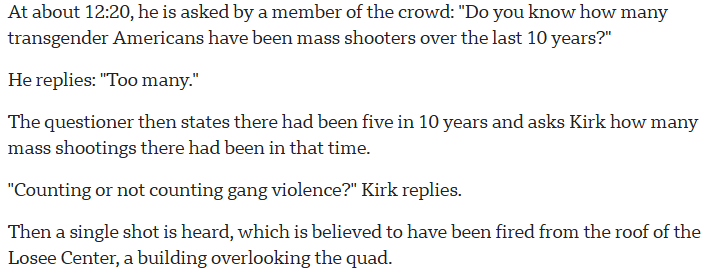
We more or less know what happens next. Kirk does his little tours, he spews genocidal rhetoric against trans people, college students protest and he makes money off the attention. His last stop was a public college in Orem, Utah surrounded on all sides by Mormon temples and a Wal-Mart supercenter. He spoke to a crowd of a few hundred in a wide-open area just around the corner from the campus’ Chick-fil-A. One moment he was riling the crowd up about “trans mass shooters” and the next, well, you know.
Some time later, when the Governor of Utah and the FBI Director gave their press conference announcing that the shooter had been apprehended, they both started their briefs with strange one-liners written no doubt by intern speech writers, overpaid consultants or an unpaid subscription to a generative AI platform. The Governor began his speech by stealing Obama’s line – “We got him” – and the FBI Director said something I’m still trying to understand – “This is what happens when you let good cops be cops” – as if the bar for capturing high profile assassins is so low that we all just assumed the police would accidentally shoot fifteen innocent bystanders and have five cases of internal fentanyl poisoning before they caught the perpetrator.
And so it goes. Thus comes to an end the short, strange story of Charlie Kirk.
So why begin this essay with a retrospective on a successful but ultimately forgettable sicko who was just another fascist in the long line of right wing American culture warriors? Because Kirk’s story is so of our time, so farcical, that it’s hard not to marvel at the absurdity of it all. Here was a guy who was indoctrinated since high school with reactionary propaganda. Here was a guy who was shown the path to the summit of all American summits: Celebrity. Shown how to live forever in the sphere of hyperindividual immortality that we’re all told from our first moments to our last that we could reach if we only try hard enough. Here was a guy who thought he could change the world all on his own, encouraged along the way by sickly old men with conservative agendas who used him, told him he was doing great, and that he was just what this country needed. He performed his duties to a T…and got absolutely annihilated by a random sniper’s bullet in front of a crowd adoring fans with cameras at the age of 31 for his troubles, his blood spouting out of his neck like a broken fire hydrant all over those enormous Trump hats, one of which will surely, one day, wind up in a museum.3
MODERN POLITICS
You ever just feel like you’re going crazy? Like if only the rest of the proles would just recognize the world as YOU see it and acted accordingly then everything would finally change and we’d all be set free? Yeah? Well, I hate to break it to you, but that is the sign of a deeply rotten politics.
What counts for politics today in the United States and the rest of the imperial core is, as we’ll later discuss, in no way socialist or really even politics as such. What we have today are a series of alienated ideas, all thoroughly detached from history and context, reacting against epiphenomena of a mode of production that is making a desperate attempt to endure against all hope. Everyone’s ideas are defined by being right. Why is this?
To begin with, if you’re anything like me, you know almost nobody who has it better off than their parents. Even if someone is ostensibly making more money than their parents ever did (probably by working at some ad agency or in coding or some shit), real wages have been stalled for 50 years and all of our waking hours are spent working one, two, three gigs to try and make ends meet. This is to say nothing of the decay of healthcare, public transit or paid vacation hours. Even life expectancy has fallen in the US since the beginning of COVID. According to a study from the National Center for Health Statistics, between 2019-2021 US life expectancy dropped 2.4 years for White Americans, 4.0 years for Black Americans, 4.2 years for Hispanic Americans and a staggering 6.6 years for Native American populations.4
But even though things have clearly been on a downhill trajectory for some time now, this has not been met by a concomitant rise in class consciousness among proles. Theorists like the late Joshua Clover attribute this to the qualitatively different moments in the cyclical movement of capital. Clover uses Giovanni Arrighi’s three-sided scheme for so-called long centuries and cycles of accumulation, in which initial waves of economic expansion take place via finance (in Arrighi’s scheme, merchant capital), followed by an expansion of industrial capital (where capital accumulates in a way we all recognize), and, once this reaches its limits, a final financial expansion. This happens because capital goes where it believes investment is safest – it really doesn’t care where that is. When the profit rate slows, capital races out of the productive sectors and into finance to invest in a series of get rich quick schemes, which usually amount to lying about the profitability of some asset before the buying party realizes how unprofitable it is.
Clover’s main insight is to tie this idea into a theory of the form of class struggle, suggesting that “phases led by material production will issue forth struggles within production, over the price of labor power; phases led by circulation will see struggles in the marketplace, over the price of goods.”5 When capital is primarily being invested in production, we see successful socialist organizing because capitalists are happy to share when things are going well and reticent to allow their greed to put the system at risk. When capital is primarily invested in finance schemes as industrial profitability slows, we see the opposite – capitalists are less willing to allow space for socialist organizing because the margins are so slim they need to be protected at all costs. Additionally, eras of investment in the finance sectors see commonplace price gouging and austerity to rescue the capitalist’s margins by any means possible. The prole reaction against this is, to Clover, usually the riot. This stands in contrast to the direct forms of economic exploitation characteristic of periods of productive sector investment, where we see strikes as the primary tactic of resistance against capital. The main point here being that perhaps the idea of class struggle all us Marxists are comfortable with, good old workplace organizing and party building, can only successfully take place in that middle period where industrial capital is on the rise, the capitalists don’t mind sharing a bit of the pie and direct economic exploitation is much more obvious.
Clover then goes on to suggest, using a version of Robert Brenner’s Long Downturn theory, that the profit rates that would be necessary to encourage large scale investment in production are no longer possible. If we believe Brenner, this means we are living through capitalism’s long, terminal crisis. This is reflected in the proletariat’s crusade against finance, which is so often directed toward various superstructural manifestations of capitalism, and seldom towards capitalism’s underlying economic base. This causes a huge variety of loosely-defined “anti-capitalist” behaviors among the proles, none of which are truly anti-capitalist in the sense that they could seriously threaten the social relations that make up the mode of production.
It’s in this way that capitalism, despite driving the world system towards a collapse, is able to mystify the sources of the misery we all feel – namely private property, production for exchange and alienated labor. What we experience as the obviously negative aspects of capitalism tend to be almost entirely superstructural: banks engaging in usury, politicians lying and stealing, worse and worse art, religious fanaticism…the list goes on and on.
This encourages a type of modern “politics” that can be defined with a few criteria.
- Hyperindividualist
- Ahistorical and detached from context
- Heavily conspiratorial
- Something that is best left to celebrities
To take the first first criteria, “hyperindividualist” here means primarily that YOU are right and that YOU have all the answers. The bourgeois ideology of individualism, whereby a series of rational actors make decisions in the supposedly classless society of capitalism that lead to them accumulating more or less wealth based on their intuition and expertise, is here brought to its logical conclusion. Call it the Oprah Ideology. Oprah Winfrey was born into more or less abject poverty in the American South. She entered the entertainment business at a young age, and eventually built a media empire that became so successful that she was, at one point, the only black billionaire on the planet. What we can say about Oprah’s story is that it is a statistical anomaly on a very extreme scale. Realistically speaking, everyone else born in Oprah’s circumstances finds themselves in the exact same circumstances when they die. But that doesn’t stop every econ major on the planet from spewing the ideology of the self-made entrepreneur, ignoring the fact that just about every capitalist not named Oprah Winfrey got their start from the best economic strategy of all, namely, having rich parents.
Because the class boundaries of capitalism are, in theory, porous, meaning any worker can technically become a capitalist and vice versa, there is a prevailing sentiment that grinding and working your ass off will somehow leave you with enough seed money to sit on a rent or become the exploiter instead of the exploited. This has the surprising effect that, as global economic conditions get worse and worse, the ideology of individualism becomes stronger. Politically, we all think we and we alone have the answers. This could be YOUR interpretation of Marx’s value theory, Marx’s politics, or, on the more liberal end, that the democrats should just be doing what YOU’VE been saying, that way they wouldn’t lose so many elections to republicans who can barely tie their shoes. Social media, the modern news delivery system of choice, has the excellent characteristic of reinforcing YOUR correct ideas by basically just monitoring what you engage with and feeding you more of it.
This leads nicely into our second criteria for modern politics, which is that it is entirely detached from historical context. Bourgeois ideologues love to pull this shit by claiming that capitalism has always existed and that it’s the “natural” state of complex human society. Current events get normalized to this natural society and become less the semi-predictable outcomes of a productive mode based on exploitation and domination and more about the bad decisions of various political actors. Trump isn’t engaging in a doomed campaign of protectionism because certain segments of the ruling classes are trying desperately to recover some semblance of profitability, he’s doing it because he’s the dumb orange guy from The Apprentice who knows nothing about economics! The fool! Studying history is transformed into reading biographies. Studying politics becomes reading autobiographies.
This Great Man theorizing of history leads everyone to become deeply conspiratorial with their politics, whether they realize it or not. When Trump had his assassination scare, nearly everyone, no matter their politics, started spewing theories about how he had either organized the whole thing as a false flag or, on the conservative end of the spectrum, that it was woke jewish transgenderism gone mad or some shit. If current events can only be explained by the isolated actions of our decrepit ruling class, the mad search for reason in a chaotic world becomes the search for connections between events and actors at the superstructural level. Trump has failed to organize a peace treaty between Russia and Ukraine not because Russia and the United States have opposing imperialist, geopolitical aims in Europe, but because Putin has a video of Trump getting pissed on!
It’s incredibly easy to think like this, in part, because things are so absurd at the moment and strange connections between disparate events are simple enough to find. This does have the effect of baffling even the most level-headed among us. If you really make an effort to understand the concrete ways in which capitalism functions, you’re predictably going to wind up finding some absurd shit. Personally, I like basketball quite a bit, and the Kawhi Leonard salary cap circumvention stuff has been fascinating to watch unfold. To give an example of how easy it is to fly off the rails into conspiracy world, let’s take a look at Leonard’s sticky situation. Anti-sports nerds just skip to the next paragraph.
It came out recently that NBA superstar Kawhi Leonard had been given a no-work-pay endorsement at a firm called Aspiration when he arrived at the sad and pathetic LA Clippers as a way of paying him more than the league would allow. Aspiration was the stupidest company on the planet. It made its money by “selling carbon neutrality” to companies by calculating their carbon footprint and planting enough trees to supposedly counteract these emissions (let’s ignore that they never planted the trees they said they did). It got a massive stock boost when Steve Ballmer, the melon-headed owner of the Clippers and former CEO of Microsoft, invested $50 million in the company which was, at that point, failing. Ballmer, wanting to drag the Clippers out of perennial embarrassment, built a new stadium for the team in a predominantly poor, black neighborhood funded in large part by the naming rights which were purchased by finance corporation Intuit. The price of the naming rights was inflated massively by a bid from…Aspiration, the company Ballmer funded and used to illegally pay Kawhi Leonard. Of the two founders of Aspiration, one is under investigation for wire fraud to the tune of ~$250 million and the other, weirdly, is not. Perhaps this is because this latter capitalist, Andrei Cherny, has been a mover and shaker in the Democratic Party for over 30 years. His accolades, comically, include losing elections for the California State Assembly, Treasurer of Arizona and Arizona’s 9th and 1st congressional districts. He was also the main drafter of the 2000 democratic party platform when Al Gore lost that world historic election to the stupidest man on the planet and was a speechwriter for John Kerry when he lost that world historic election. But don’t worry, because the guy that has been an integral part of just about every major democratic fuckup for the last 25 years is back writing policy for the next democratic presidential candidate with a project he calls “Project 2029”.6 All of this to say, if you’re like me and sometimes just want to know a little bit more about your favorite pastime, you wind up going down a rabbit hole that leads you to the Lovecraftian knowledge of how inbred our modern political establishments are and how closely intertwined every aspect of capitalist society is with greed and power. And how it’s always like the same 100 capitalists at the center of it all.
Okay anti-sports nerds, you can come back now.
Finally, this gets us to my personal favorite aspect of the psychotic shitshow we call modern politics: celebrity. Whether we want to admit it or not, we all fall into the trap of believing that part of the key to changing the world is our celebrity of choice. For the MAGA chuds out there, this is obviously just the swamp-draining president. For liberals it’s whoever is organizing the next Live-Aid, or perhaps Biden or Harris or Buttigieg or whatever vampiric consultant is next in line for the throne. For socialists it’s Sanders and Corbyn when it seems like they might get elected/become prime minister, and when they lose it’s Paul Cockshott (🤮), Andrew Kliman, Michael Heinrich, Mike MacNair or whoever the guy is at the RCP that doesn’t believe in the Big Bang.
Crucially, however, this celebrity also includes YOU. Change is not longer affected by collective action, it’s done by spewing the “right ideas” loud enough for everyone to hear. This is why you had to sit through your friend from high-school’s Instagram story about “WHY YOU ACTUALLY SHOULDN’T GLORIFY THE CHARLIE KIRK SHOOTER ACTUALLY” and why that person, and everyone else, is hard at work building a “brand” or side-hustle of one type or another. Ideas, just like everything else, are commodities, and those commodities are bought and sold, traded on a market that encourages hot takes that are easy to identify with. It’s why everyone has a Palestinian flag as their avatar but refuses to go to protests or **** ********* making ******* for ******.
I hate to psycho-analyze the guy, but the Charlie Kirk shooter was probably just trying to be a Celebrity like the rest of us. Celebrity, used here, refers to a mythological level of ideology that exists separately from the person who supposedly is The Celebrity. TAYLOR SWIFTTM isn’t actually the probably quite nice and agreeable human named Taylor Swift. DONALD TRUMPTM means so much more than just the failson of a New York real estate developer. Celebrity is a sphere of ideological status that everyone is trying constantly to achieve, because we all believe it’s the only way to a) make our difficult lives retroactively mean something, and b) affect change. The cruel irony of Celebrity is that once achieved, it kills the human that was the host. Trump has been driven insane by being given everything he could ever want and consistently failing until he became president, the Kirk shooter was driven to such extreme alienation in his drive to become a Celebrity that it all culminated in an act of shocking, public violence. Celebrity kills. Modern politics kills. What now.
WHAT NOW.
What stochastic acts of political violence like the Kirk shooting seem to show us that things are cooked. Perhaps irreparably. I don’t mean that in the pearl-clutching liberal way, I mean it in a political sense. Politics for us socialists has always been a collective act. It unfolds at the class level and serves as the mechanism through which a Marxist theory of conflict is realized by classes acting for themselves. But we have to be careful with our vocabulary here. “Conflict” is a very slippery term. What do we mean by that?
In the liberal view of politics, conflict exists in terms of ‘problems’ which need to be ‘solved’. The hidden assumption is that conflict does not, or need not, run very deep; that it can be ‘managed’ by the exercise of reason and good will, and a readiness to compromise and agree. On this view, politics is not civil war conducted by other means but a constant process of bargaining and accommodation, on the basis of accepted procedures, and between parties who have decided as a preliminary that they could and wanted to live together more or less harmoniously. Not only is this sort of conflict not injurious to society: it has positive advantages. It is not only civilized, but also civilizing. It is not only a means of resolving problems in a peaceful way, but also of producing new ideas, ensuring progress, achieving ever-greater harmony, and so on. Conflict is ‘functional’, a stabilizing rather than a disruptive force.
The Marxist approach to conflict is very different. It is not a matter of ‘problems’ to be ‘solved’ but a state of domination and subjection to be ended by a total transformation of the conditions which gave rise to it. No doubt conflict may be attenuated, but only because the ruling class is able by one means or another—coercion, concessions, or persuasion—to prevent the subordinate classes from seeking emancipation. Ultimately, stability is not a matter of reason but of force. The antagonists are irreconcilable, and the notion of genuine harmony is a deception or a delusion, at least in relation to class societies.7 (emphasis ours)
Clearly, the conflict that a socialist politics is attempting to solve cannot be done through normal, bourgeois channels. That’s the whole point. Even if you’re one of these social democrat Leninist/Kautskyist types (aka Stalinists with good intentions), you recognize that sooner or later in your crusade to institute the democratic republic, you’re going to have to break the rules of the game. Bourgeois law will have to be broken, because bourgeois law is the thing that keeps the whole mode of production in check and ticking along.
To speak in more concrete terms, capitalism relies on two distinct types of violence, without which, it would not be able to function. The first is economic – money is coercion. Our entire productive apparatus is put to use for the sole purpose not of meeting needs, but for maximizing exchange value. The way in which you’re forced to get up everyday and work for this system of profit is through your wages. Capitalists do not pay workers a certain percentage of the value they create, with wages going up or down depending on the productivity of the work being done. They pay workers what their labor power is worth. Which is to say, how much it costs to reproduce a worker of such and such a type. Waiters require less training from society than doctors, for example, so are paid less because it is much cheaper to replace a waiter than a doctor. Regardless of your wage, however, the fact that you have a wage means you rely on it to survive, and so are forced to sell your labor power to some prick capitalist in order to have a roof over your head and food in your stomach.
The second type of violence required by capitalism is much more obvious, and this is the repressive function of society. From local cops in small towns with tanks and automatic weapons at their disposal to national armies with drones and fighter jets, from jumbo-headed ideologues spreading messages of hate to coerce workers to stay in line or propaganda aimed to make your feel no empathy for suffering workers in other countries, it’s violence all the way down. Violence designed to keep you going to work to reproduce class society, to make you hate anyone who questions why things are like this, to maintain the status quo.
These types of violence are more or less apparent depending on the economic state of society. When times are bad, workers have less to lose questioning the tenants of class society. Sometimes, very rarely, when times are really bad, we actually realize that there is everything to gain from this kind of questioning. Wars particularly have a way of shattering the illusions of class society and provoking workers into action, though this very rarely equates to “bringing the war home” in the imperial core. It radicalizes a certain already progressive strata of the working class by proving to them that without the threat of game-breaking counter-violence against the state and the capitalists, you’ll just be allowed to protest every weekend and very little will change.
The first task of any revolution is to abolish the threat of both forms of violence once and for all. We’ve spoken about this at black mold before, but the general idea is not an outright confrontation with the capitalist state. That is a losing strategy. The goal needs to be to somehow dissolve the social bonds that keep these structures of violence in place. It’s really only from this starting point that the social relations of socialism can be born.
“So okay edgelord,” we hear you saying. “You sit there in your little Marxist ivory tower looking down on the simpletons and their anti-war protests, banging on about a class war as the only real option like the old man yelling at the cloud. What’s the alternative?”
THE ALTERNATIVE?
Okay, look. Whenever you talk about “what needs to happen in order for real change” you run the risk of coming across like an asshole, so let’s get a few things out of the way first.
In no way are we saying that protesting, soft agitation or even (ugh) zine writing are wastes of time. If anyone ever tells you that they’re either a cop or someone so far up their own ass they’ve lost sight of what the non-ass world actually looks like. Even though we’re old enough to remember going to anti-war protests for Afghanistan and Iraq and Sudan and living through some of the largest single day protests in human history, only to see those demands amount to jack shit and the blood sacrifices to capital continue unabated, protests, for example, do serve a very real function. They cohere groups of agitators together and form social bonds that, without this level of practice, would otherwise go formless. Think back to your own radicalization. It didn’t just happen sitting at a computer, it almost certainly happened seeing hundreds or thousands of people like you in the streets demanding something better. This soft-questioning of the power of capital may not have everyone alongside you demanding a system of cascading communist workers’ councils, but they do shift the window to the left, making it clear that you are not alone in your alienation.
But, realistically, as we’ve seen with Israel and the west’s 75+ year war of ethnic cleansing in Palestine and the massive attendant protests around the world in the last two years, very little changes unless it is forced to change. Protests, for all their cohesive action, do not actually break the rules of the game. They question it, sure, and they lead more and more people to realize that wars and genocides aren’t aberrations of the capitalist system but inherent parts of it, but that doesn’t stop the slaughter.
If we go back to Miliband’s definition of Marxist conflict, we see exactly this. The fundamental contradictions and misfortunes of capitalist society – exchange value vs. use value, private property, alienated labor, etc. – are all states of “…domination and subjection to be ended by a total transformation of the conditions which gave rise to it.”8 Of course, this doesn’t mean don’t try and attenuate the worst epiphenomena of capitalist society as best you can. It’s simply an acknowledgment that until enough workers see capitalist social relations for what they are – the driving force behind war, economic crisis, inequality and ecological collapse – and feel they must act against them, this fundamental conflict will persist.
So what of our earlier definition of a socialist politics? A collective act performed at the class level through which a Marxist theory of conflict plays itself out. Hopefully by now it should be obvious where this essay is headed. The key to having a really socialist politics capable of transforming the world is, frustratingly, the collective part of that sentence. No one is capable of changing the world and ripping apart class society once and for all on their own. No one act is going to cause the ruling class to throw up its hands and go “damn we were wrong huh?” This is a deeply impersonal system in which production decisions (and thus political decisions) are not made by some entrepreneurial set of capitalists or enlightened politicians. These decisions are all made by capital, by self-expanding value, and the only rule of the game is to keep accumulating. So as the game starts nearing its end in one way or another, as our ecology collapses, profit rates tumble and more and more capitalists seek refuge in outright frau-, uh, I mean finance, collective action is a necessity.
The point of action now becomes the shattering of this hyperindividualist political facade that hangs over all parts of capitalist society, mystifying and obscuring its core tenants, and doing this in a way that insights purposeful action…before the whole thing collapses on its own into a mess of directionless chaos.
REFERENCES
- These lines are, of course, from Buck Owen’s Act Naturally, though the idea for using them in this context came from the cover (rewrite?) of the song by The Nerve Institute. ↩︎
- Tiffanie Turnbull (2025). “Suspect in custody and named as Tyler Robinson – what we know so far”, BBC News. Online:
https://www.bbc.com/news/articles/cy04p4x21e5o ↩︎ - It appears, in fact, that the hats were immediately stolen by a young man posing and filming himself for social media as the crowd around him was screaming and running for cover, yelling “It’s ya boi, eldertiktok…this is not a drill, there is a gunfire in Utah, shots fired…read the book of Mormon…bruh I’m not even lying, make sure you subscribe to eldertiktok in Instagram”. ↩︎
- Elizabeth Arias, et al. (2022). “Provisional Life Expectancy Estimates for 2021”, National Center for Health Sciences. ↩︎
- Joshua Clover (2016). Riot. Strike. Riot. ↩︎
- Shane Goldmacher (2025). “Sound Familar? Democrats Lay Groundwork for a ‘Project 2029’”, New York Times. Online (use removepaywalls.com):
https://www.nytimes.com/2025/06/30/us/politics/democrats-project-2029.html ↩︎ - Ralph Miliband (1977). Marxism and Politics. ↩︎
- Ibid. ↩︎
 black mold